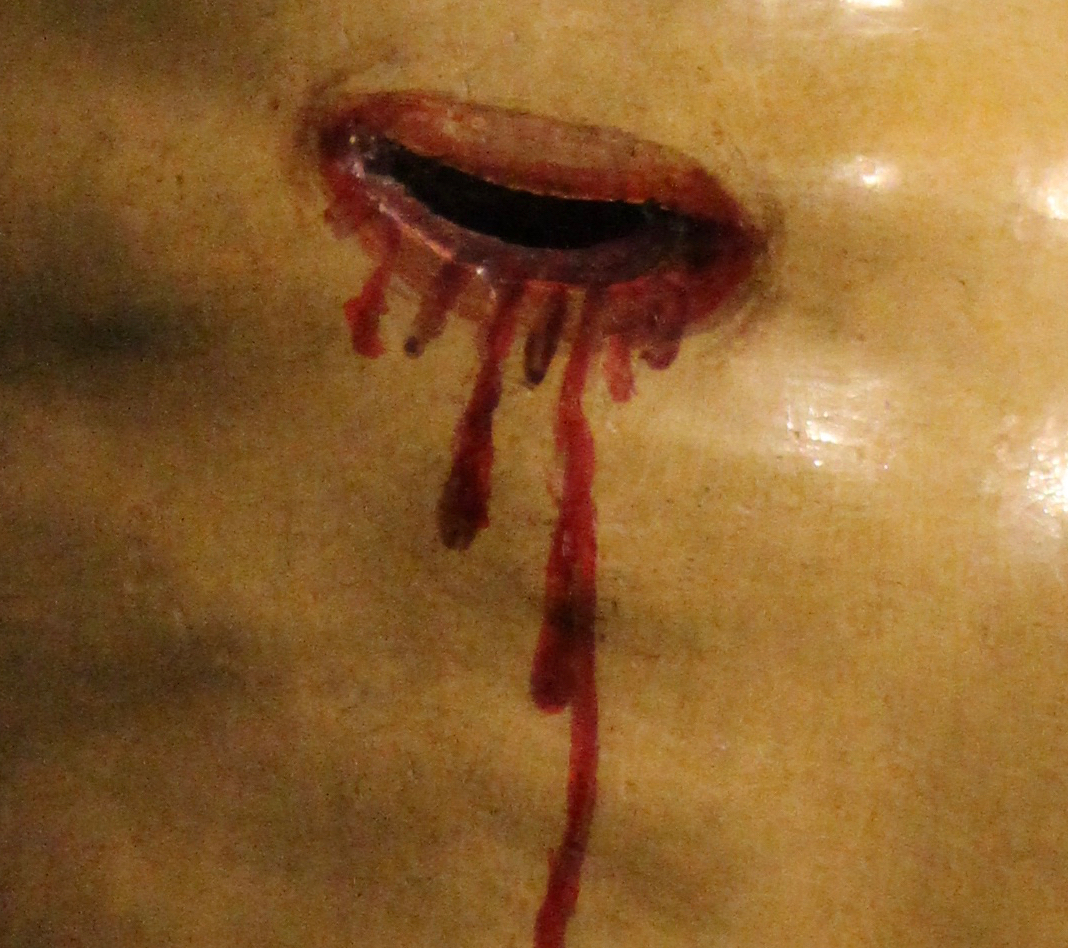
Sumptuous silk, the blush on a beauty’s cheek, and the blood gushing from Christ’s wounds were painted on sculptures in hues from rose to tomato to crimson. Red adorns and enlivens these often life-sized works, making them seem not mere wood, terracotta and other materials, but flesh and blood.
Reds were expensive pigments, surpassed only by gold and blue. Vermillion, made from mercury, was recognized to be toxic, but sought-after for its enduring rich hue. Recipes for paints fill an early Renaissance handbook, but the reader is told to “ask the monks” about this desirable but dangerous pigment. Likewise, the even more prized red lake, often made from bugs from the Middle East, was tricky to create from rare materials.

A terracotta sculpture of the Virgin Mary holding baby Jesus embodies the preciousness and loveliness of red. Red fabrics were the most expensive, and so it makes sense that Mary and Jesus both have red cloth against their skin, in addition to the extravagant blue and gold veils enveloping them. Red bole, a sticky clay, was used underneath the gold, in order to give gold a warm hue. Mary’s dress, painted with a red lake over silver leaf, would have originally have evoked the shimmer of silk, but now the silver has tarnished. The skin of the mother and baby was painted with lead white mixed with a green earth (terre verte), and then glazed over with a more lead white, this time mixed with vermillion. The pink of their cheeks and lips contrasts with the cooler, pearly flesh. In its original location, probably hung just above eye level in the bedroom of a wealthy Florentine, the tenderly interlacing hands and legs would be closest to the men, women, and children of the house, who would look up to and possibly touch or kiss the sole of Jesus’ foot, painted naturalistically flushed. Indeed, some paint has been lost on the baby’s right foot, perhaps because this rosy appendage was too tempting not to touch.
The Virgin Mary almost always wears a red dress, with a blue mantle and veil. Some Renaissance sculptures show Mary only wearing her red under-dress, as originally these works were dressed in an actual fabric cloak. Because it would have been only glimpsed underneath this cloak, the brilliant red of Mary’s dress in this wooden sculpture is left undecorated, with only gold cuffs and a contrasting green belt, similar to ones women would have worn in the period.
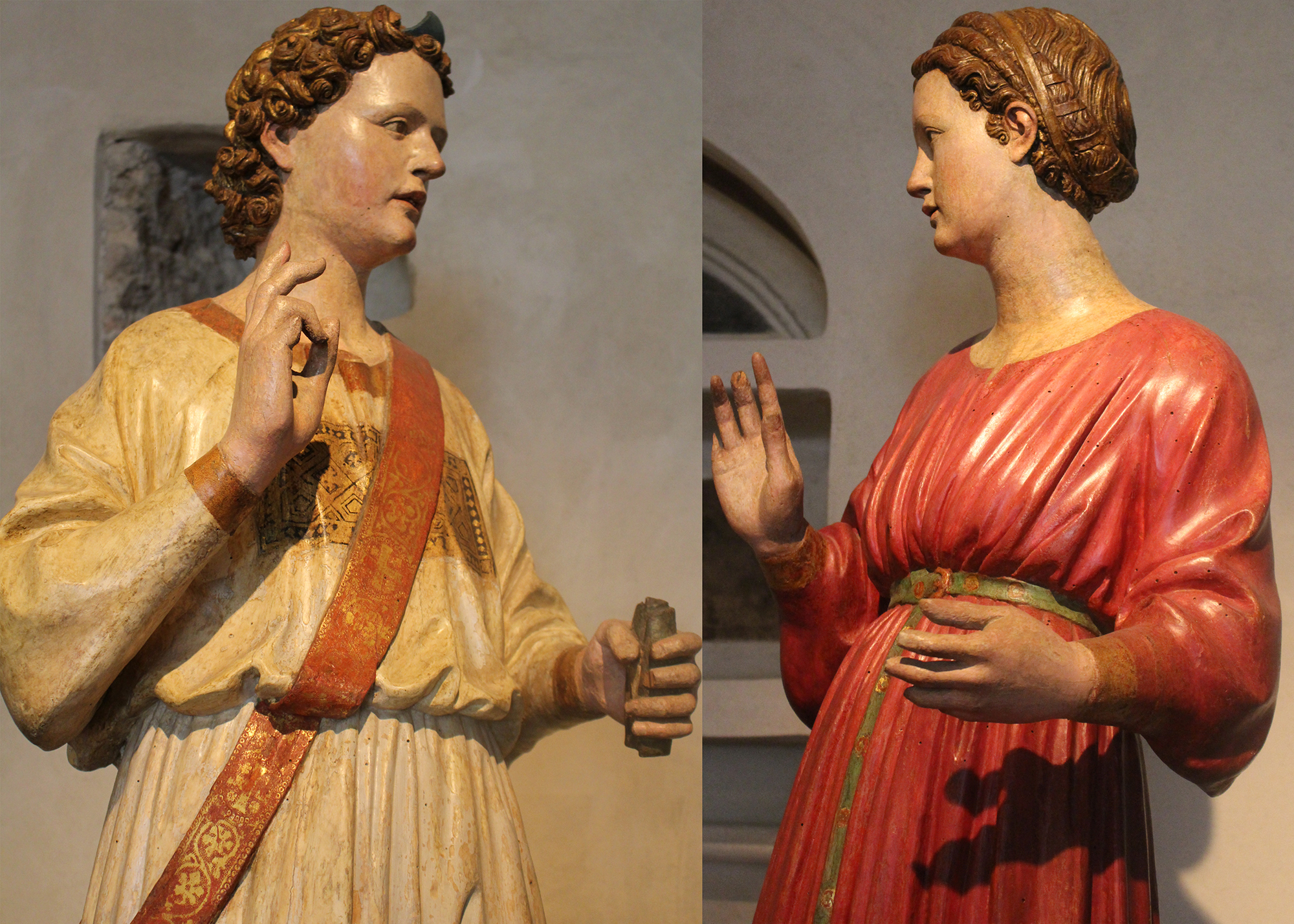
This sculpture is paired with another of the Archangel Gabriel, who is telling Mary that she is pregnant with Jesus. Gabriel’s flushed cheeks convey his urgency, and his red and gold accessories connect him to Mary and signify his status as the messenger of God. Mary bends back, startled by this extraordinary news, the curve of her red-draped body intimating what is happening inside her protruding belly, as Jesus becomes flesh and blood in her womb. Later, starting around 1500, artists depicted Mary with a white undershirt beneath her gown, but in in the 1300s and 1400s, red fabric touched Mary’s body, making red the colour of intimacy.
 A blush on pale skin was considered the height of beauty, but a reddish complexion, especially in women, was thought ugly. Upper class women remained indoors and used make-up to achieve the desirable cool pearly flesh and warm blush. Preachers decried these cosmetics, often made of the same toxic materials as paint. In this sculpture of Saint Mary Magdalene, the ideals for female beauty are inverted, including the red of her skin. The Magdalene was thought to have been a beautiful prostitute before she converted and became a fervent follower of Jesus. Popular accounts tell of her living naked in the wilderness, depriving her body of food and comforts in order to purge her sins. Her hair, we are told, grew miraculously long to cover her nakedness. Rather than the plump cheeks, high smooth forehead, and rosebud lips expected in a woman, this skeletal, gap-toothed figure with exposed muscular arms and a wide-legged stance looks almost masculine, according to Renaissance standards. Her skin, instead of being painted with the pearly green tones to balance the hint of red, does not have any cool colours but only lead white and vermillion, in some places with an under-layer of red ochre, giving her a ruddy complexion. Only the gold leaf on her hair elevates the figure. Vermillion, an expensive pigment that makes other women lovely here suggests the opposite – a deliberate ugliness, a mortification of the body.
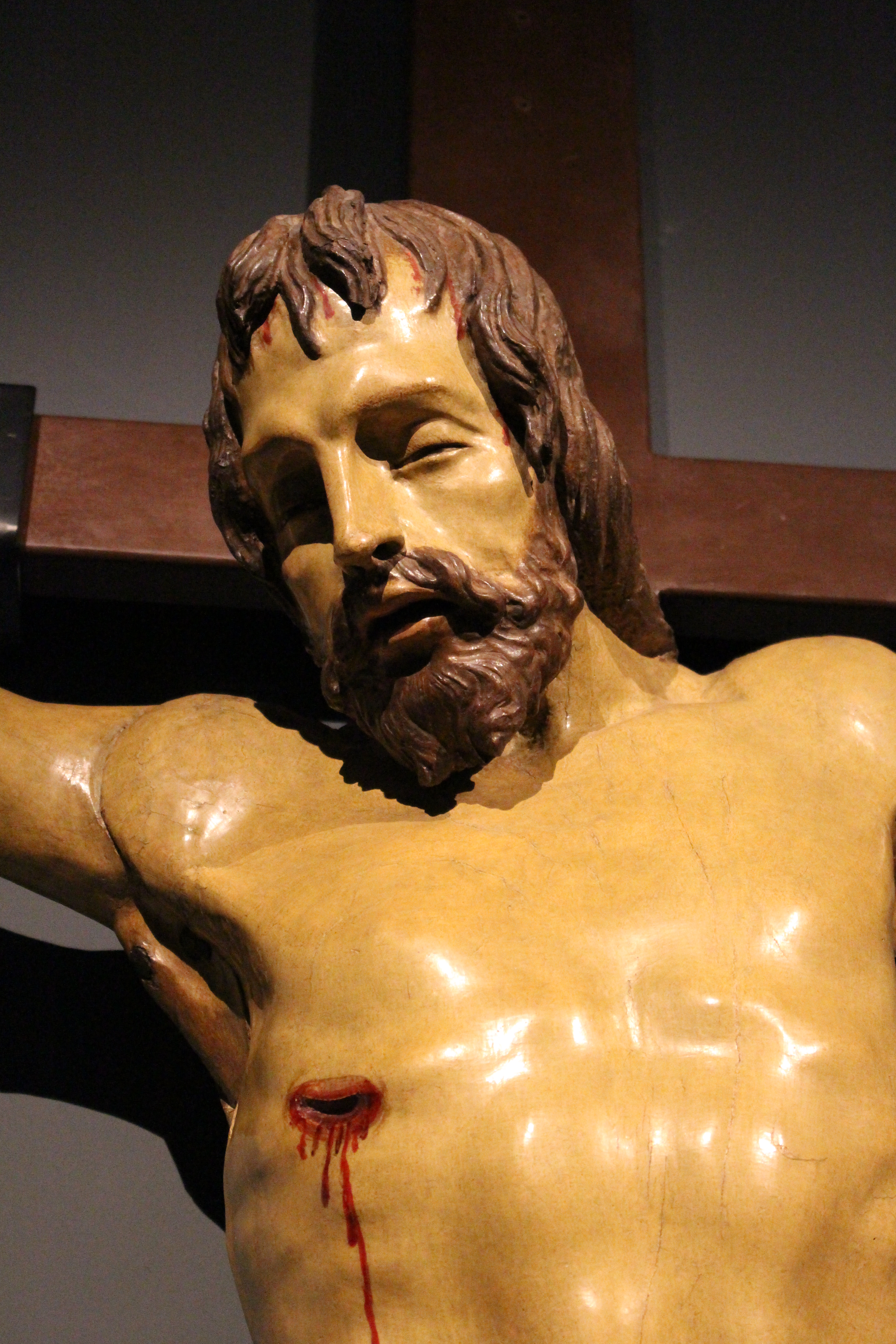 Red blood, which seems to run beneath the warm flesh of so many of these naturalistic sculptures, drips and pours out of the wounds of Jesus Christ in sculpted crucifixes. Renaissance preachers and mystics describe Christ’s blood as the most precious of substances, sweetly fragrant, but also horrifyingly gory. Devotees would say prayers, imagining Christ’s suffering happening in front of them. Here, the wound in Jesus’s side seems to be bleeding, some drops already dried on the skin and darker red, others brighter, looking fresh. The blood is roughly painted — almost splashed or dripped — compared to the delicate strokes used to paint such details as Jesus’ eyelashes. But the painting of the blood is actually complexly layered: red lake glaze over vermillion, with brown glaze around the edges of the wound to make it look swollen. The painter used multiple reds to create an illusion that Christ is bleeding.
Red was vital, but the Della Robbia family, famed for the lustrous hues of their glazed terracotta sculptures, were never able to create a red glaze, and so added red paint after glazing, which did not adhere well to the slick surfaces. In an altarpiece of the Crucifixion, for example, angels hold chalices to catch blood that is no longer there. 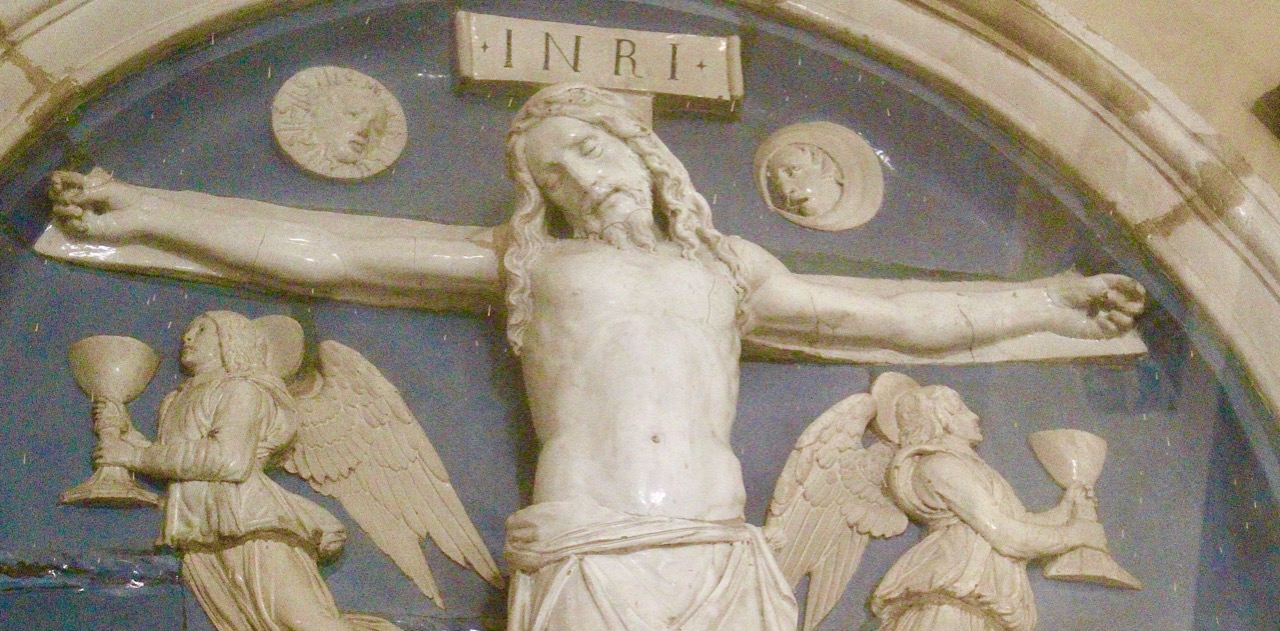 Without red, Christ’s sacrifice can no longer be made vividly present.
Beautiful, ugly, luxurious, and violent, red brings Renaissance sculptures to life. These colours, made of metal, earth, and bugs, transform the underlying sculptural materials, adding flesh. In the Renaissance, sculptures blushed and bled.
Prof. Una Roman D’Elia, Queen’s University
Please note that all images are available, with further information, on the Renaissance Polychrome Sculpture in Tuscany website (qspace.library.queensu.ca/handle/1974/14832).
Images:
Fig. 1. Detail of Madonna and Child, painted terracotta, ca. 1425?, Museo Bandini, Fiesole (photo: Una D’Elia)
Fig. 2. Detail of Francesco di Valdambrino, Archangel Gabriel, painted wood, ca. 1411, Museo Civico, Asciano (photo: Una D’Elia)
Fig. 3. Detail of Francesco di Valdambrino, Annunciate Virgin, painted wood, ca. 1411, Museo Civico, Asciano (photo: Una D’Elia)
Fig. 4. Detail of Donatello, Saint Mary Magdalene, painted wood, ca. 1455, Museo dell’Opera del Duomo, Florence (photo: Una D’Elia)
Fig. 5. Detail of Donatello, Crucifix, painted wood, ca. 1408, Santa Croce, Florence (photo: Una D’Elia)
Fig. 6. Detail of Andrea della Robbia, Crucifixion, glazed terracotta, ca. 1500, Santa Maria Primerana, Fiesole (photo: Una D’Elia)
Bibliography:
Bucklow, Spike. The Alchemy of Paint: Art, Science and Secrets from the Middle Ages. London: Marion Boyers, 2009.
Cennini, Cennino. The Craftsman’s Handbook. Trans. Daniel V. Thompson, Jr. New York: Dover, 1960.
Galeotti, Monica, Rosanna Moradei, Akiko Nishimura, and Laura Speranza. “Una terracotta policroma degli inizi del XV secolo.” OPD Restauro 20 (2008): 35-56.
Kubersky-Piredada, Susanne. “The Market for Painters’ Materials in Renaissance Florence.” In Trade in Artists’ Materials. Markets and Commerce in Europe to 1700, ed. Jo Kirby, Susie Nash and Joanna Cannon, 223-43. London: Archetype Publications, 2010.
Lalli, Carlo, Pietro Molloli, Maria Rizzi, Claudio Seccaroni, Laura Speranza, and Peter Stiberc. “Il Crocifisso di Donatello nella Basilica di Santa Croce a Firenze.” OPD Restauro 18 (2006): 13-38.
Pastoureau, Michel. Red: The History of a Color. Trans. Joyce Gladding. Princeton and Oxford: Princeton UP, 2017.
Seidel, Max, ed. Da Jacopo della Quercia a Donatello: Le arti a Siena nel primo rinascimento. Exh. cat. Siena: Santa Maria della Scala, 2010.
Speranza, Laura. ” La Maddelena penitente di Donatello.” In Il restauro del Crocifisso ligneo di Donatello nella Chiesa dei Servi di Padova, ed. Elisabetta Francescutti, 163-72. Padua: Centro Studi Antoniani, 2016.


