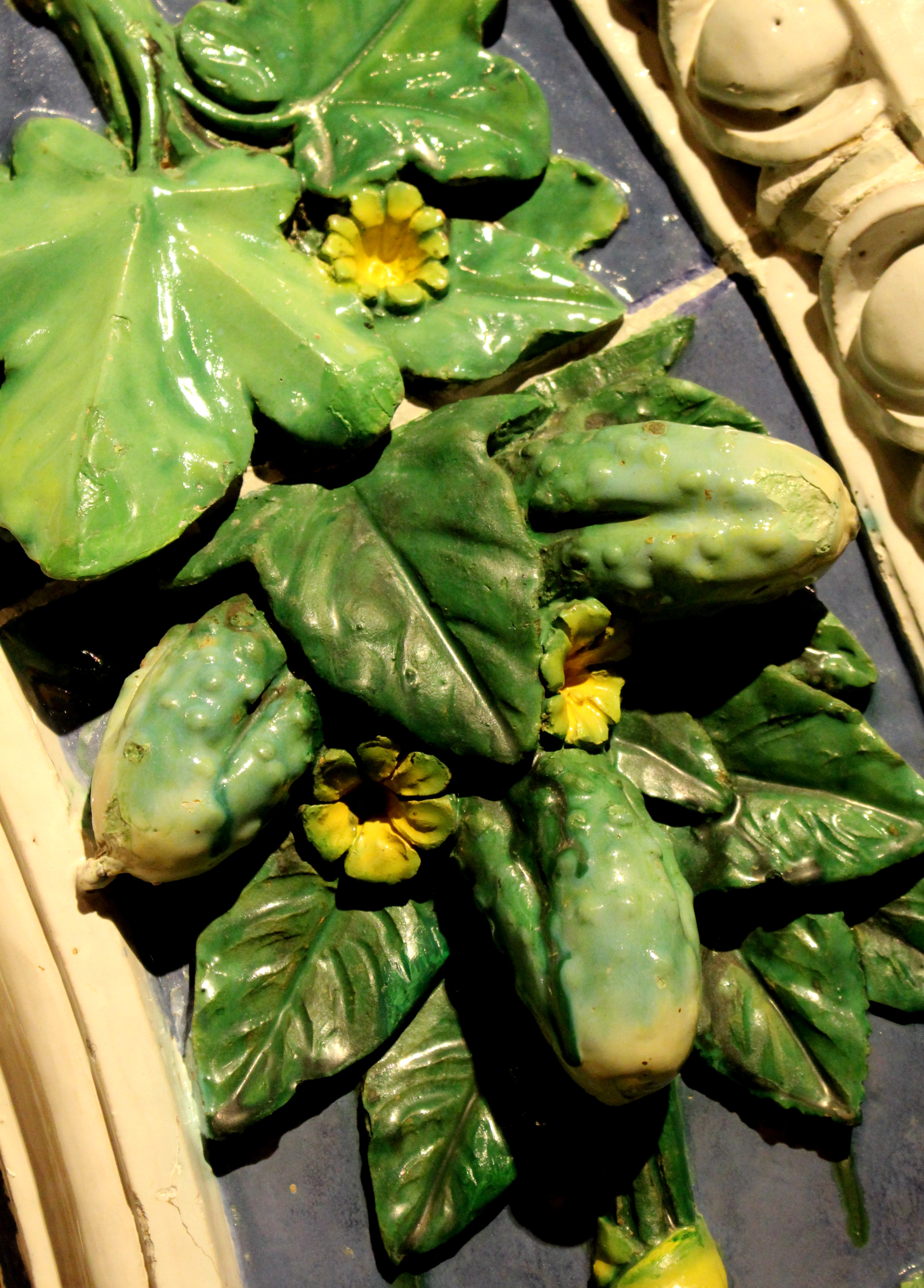
Blooming flowers and vivid fruits, delicately surrounded by green, furling leaves, often framed devotional images. The long, fragile stems of the Virgin Mary’s lilies were carefully coloured with green. So were the swaying palm leaves of martyrs and the soft grasses that nestled the infant Christ in his manger. Green was also used subtly when painting human skin, lurking beneath luscious reds to produce naturalistic flesh tones. Without the flush of red, however, green skin was used to evoke the pallor of death; the dead body of Christ, for example, was often tinted with green.
In Renaissance Italy, green was an unstable colour, easily prone to changes. Cennino Cennini, in a treatise of ca. 1400 CE, named it as one of four ‘earthly’ colours, alongside black, yellow, and red. However, capturing it in pigment or dye was notoriously difficult. Verdigris, chemically known as copper acetate, was the most unstable pigment, especially when used with lead white. Malachite, the most expensive green, produced a brilliant colour, but did not react well to acidic compounds. Like verdigris, it had the tendency to dull and darken over time. Terre verte was famed for its durability, but produced a duller green by comparison.
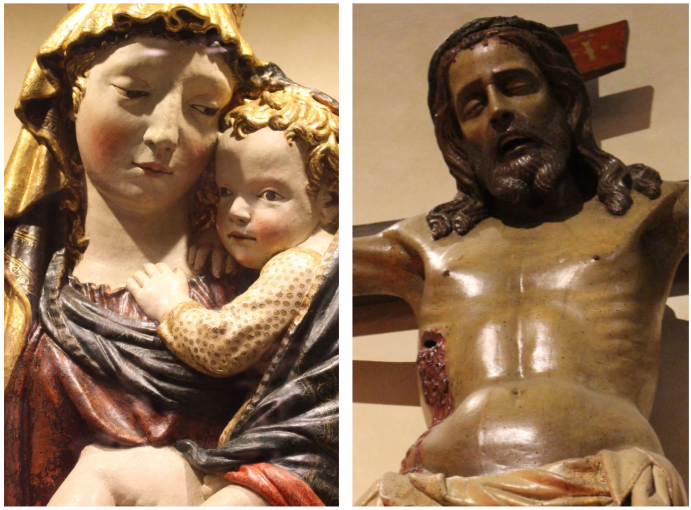
Right: Orcagna, Crucifix, painted wood, ca. 1360, San Carlo dei Lombardi, Florence (photo: Una D’Elia)
Although the colour green is not visible, the lifelike quality of this painted Madonna and Child could not have been achieved without it. When painting flesh, terre verte was often used to neutralise pinkish reds. Green pigment would have been applied under red, softening its vibrancy. This resulted in delicately flushed skin tones. Terre verte was so durable a pigment that it often outlasted the pinks and reds applied on top. In this 14th century crucifix attributed to Orcagna, Christ’s skin is tinged with a greenish hue. It is unclear whether this was intentional, or if this is a preservation issue. Either way, the terre verte originally applied has clung to the wood, a testament to its durability.
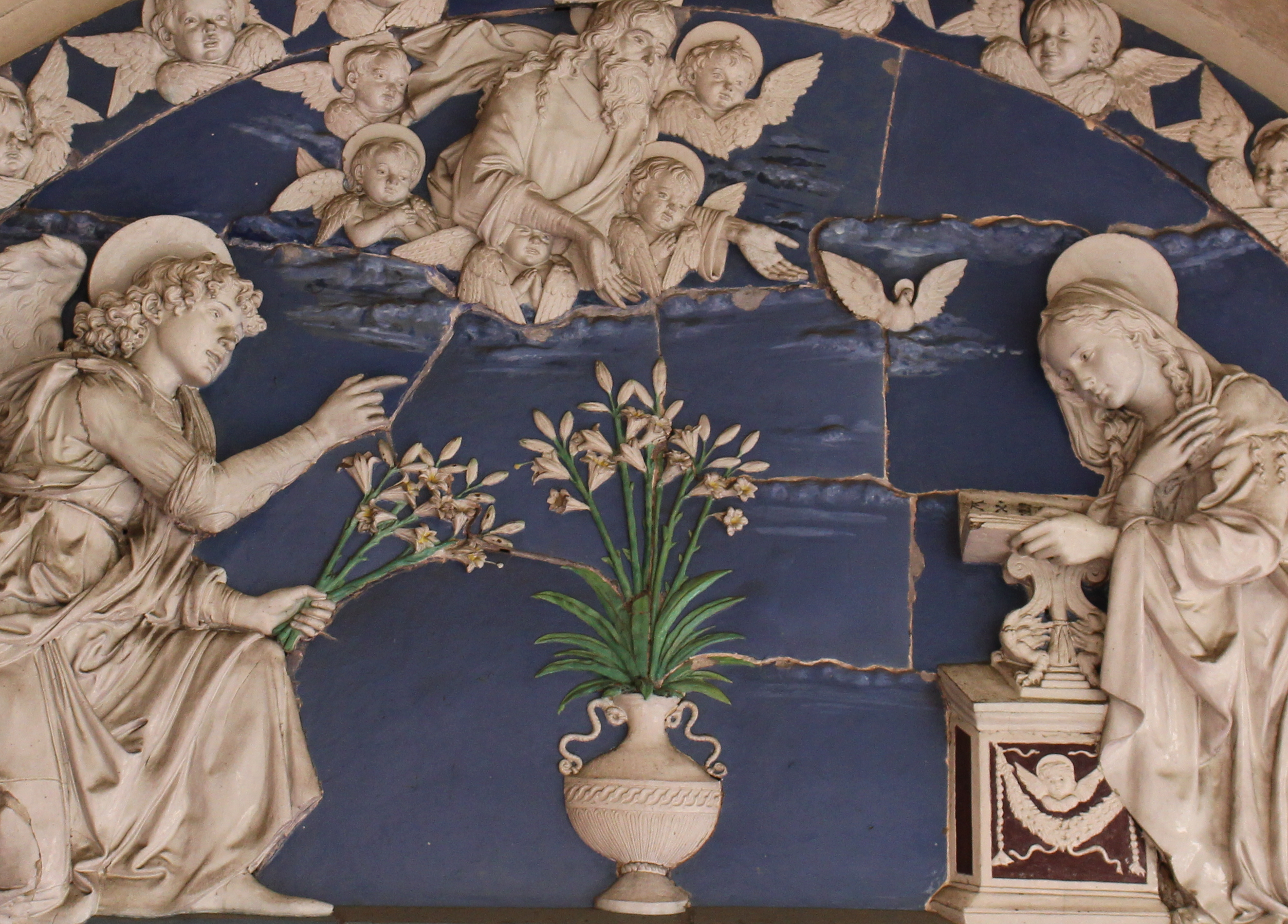
The Della Robbia workshop used copper resinate for its green glaze. Unlike the pigments used in painting, terracotta glazes remained permanently brilliant. In this lunette, Mary and Gabriel are portrayed on either side of a radiant bouquet of lilies. A cascade of green stems and leaves curl over the white vase. Gabriel holds another sprig of lilies as he brings Mary the news of Christ’s miraculous conception. Closely tied to chastity, lilies feature prominently in depictions of the Annunciation, and as a symbol of the Virgin Mary. Green is in the centre, uniting the figures. The verdant stalks of these naturalistically depicted lilies add life to the stylized figures, evoking Mary’s chaste fertility.

The Della Robbia workshop was famed for its faithfully tender portrayal of children, exemplified in this gentle depiction of Christ. Rather than resting on a bundle of brown hay, as he does in most Renaissance paintings, the infant Christ lies on fresh, green grass. The verdant plants, coloured as they would be in nature, make up a soft bed for his delicate body. This tondo is encircled with an ornate wreath, with various greens illuminating its leaves. This bright array of vegetation draws the eye to the central Adoration. Green grass invokes the essence of freshness and new growth, especially when contrasted to the ethereal figures of Mary, Jesus, and the angels. In the Renaissance, green was often associated with springtime, renewal, and youth. Here, the greenness of the infant Christ’s bed invites the viewer to share in the Adoration.
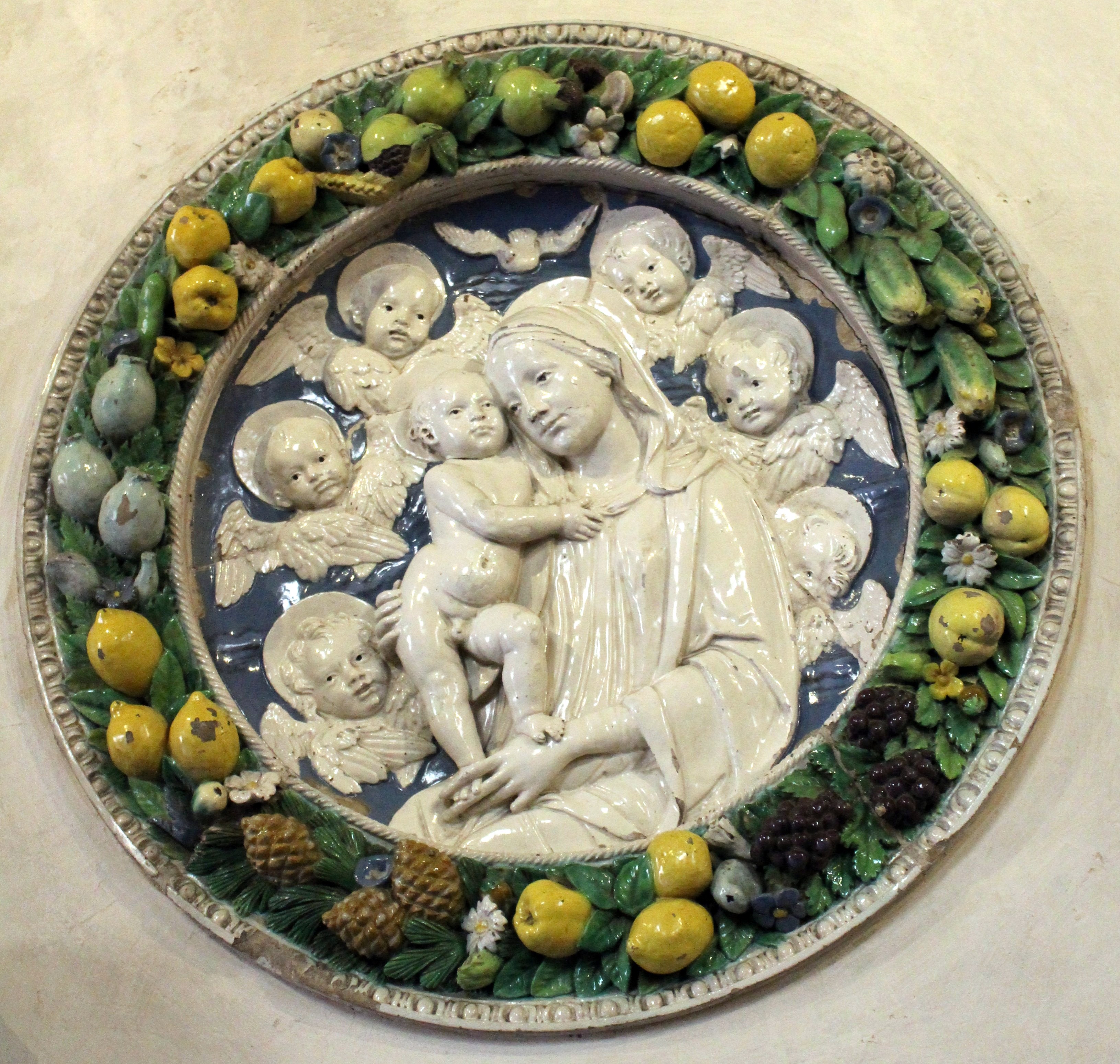
In this tondo, the opaque whiteness of the Virgin, Child, and angels would have glowed in candlelight. This was likely a piece meant for domestic devotion. White figures swirl together, framed by a hint of blue sky, and encircled with another brilliant garland. Naturalistic, ornamental frames of this kind were so indicative of the Della Robbia workshop that the style of adding fruits to evergreen garlands is named after them. Here, easily identifiable plants (grapes, pomegranates, pinecones, lemons, and pears) are coloured with botanical precision. The garland frame is cast in higher relief than the figures inside. Note the variety of hues used for each plant, while the inner figures are elevated in pure white. No colours differentiate skin from cloth. Vividly coloured wreaths reminded worshippers of God’s beautiful creations, drawing the eye inward, just as gilt frames call attention to the paintings they contain.
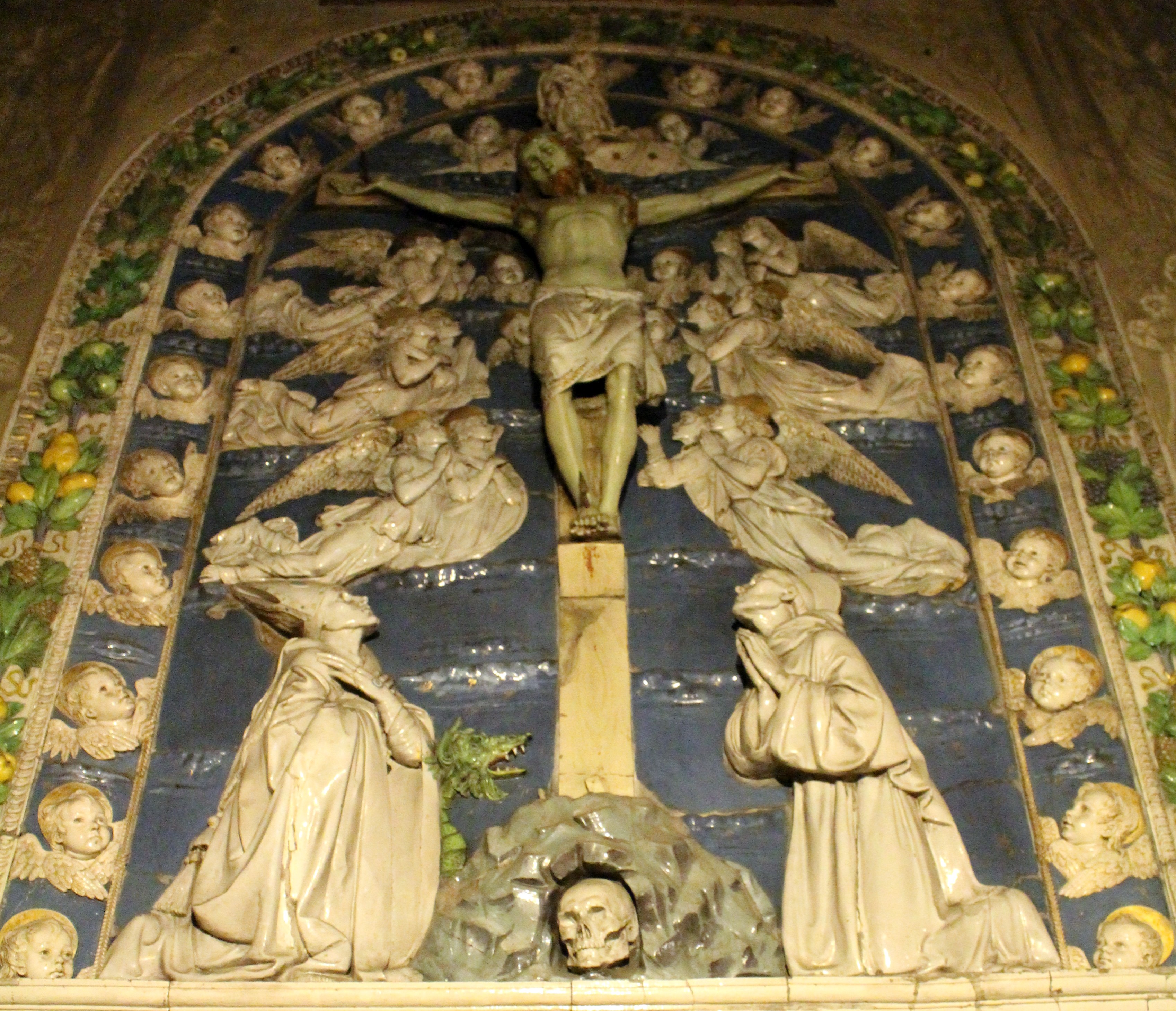
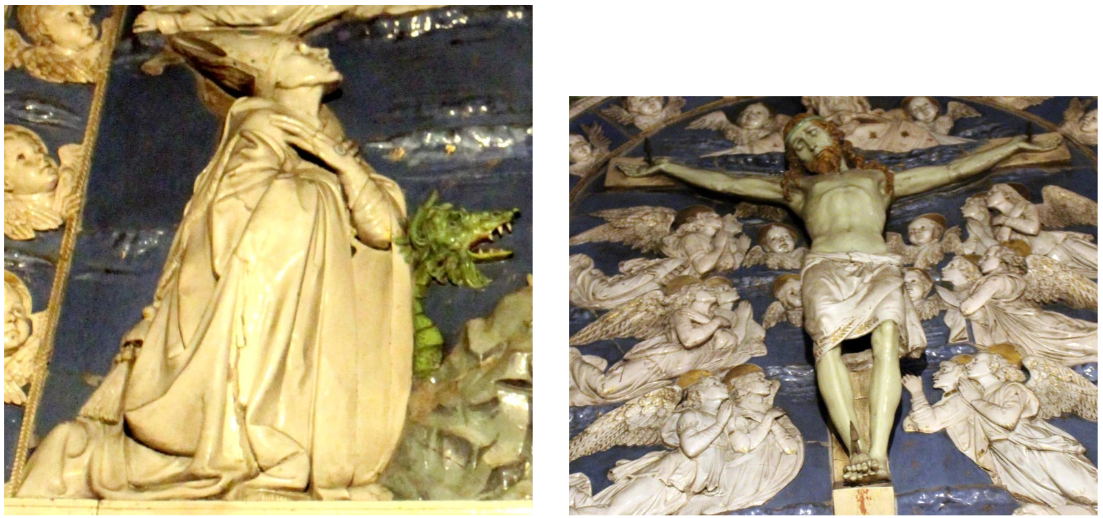
Green was not only the colour of freshness, fruit, and flowers. Hidden, poisonous creatures thought to accompany the devil, such as snakes, lizards, and frogs, were proof of the colour’s deceitful nature. Also coloured green were feared monsters such as the basilisk or dragon. The patron saint of Arezzo, Saint Donato, is depicted with a dragon emerging from his left. According to legend, Saint Donato slew a dragon that had poisoned the local well. The vivid green used for the dragon of this altarpiece is also used to colour some of the lush garland frame. On the dragon, the bright colour is alarming. A far paler tint is used for the decaying flesh of Christ’s body. The ornate frame of this altarpiece uses green to enliven fertile vegetation, emulating the surrounding Tuscan landscape, but green also represents the Satanic bestiary, as well as the putrefied colour of dead flesh.

The green of decaying flesh may have evoked visceral reactions in churchgoers who worshipped at scenes of the Crucifixion. However, green could also be used with a sense of renewal, demarcating the boundaries of the earthly and divine. This lunette depicts the story of Mary’s ascension to heaven. Annunciate lilies marked the coming of Christ and the sacred fertility of the Virgin Mary. Alongside roses, they now mark her death. Mary’s tomb is covered in the green leaves of delicate white blooms. Flowers reach upwards, guiding the eye to Mary and her heavenly retinue. The serenity of these ascending, white figures provides a visual reference for meditative prayer. As Mary rises bodily to Heaven, the green mass of flowers cover her tomb and embody the memory of her presence on earth.
Flowers, trees, and vegetation are signifiers of life and natural beauty. These green, growing things emerge from earth. That same earth was taken and transformed into terracotta, which was then sculpted, painted, and fired to imitate God’s creations in an everlasting way. Green grows, blooms, dies, and rots: such is its nature in life. However, the green glaze of these polychrome sculptures survives, untouched by the ravages of time.
Nuard Tadevosyan, Queen’s University.
Please note that all images are available, with further information, on the Renaissance Polychrome Sculpture in Tuscany website.
Bibliography:
Alberti, Leon Battista.On Painting.Trans. John R. Spencer. 2nded. New Haven: Yale UP, 1966, pp. 49-50.
Cennini, Cennino. The Craftsman’s Handbook. Trans. Daniel V. Thompson, Jr. New York: Dover, 1960.
Edgerton, Samuel Y. “Alberti’s Colour Theory: A Medieval Bottle without Renaissance Wine.” Journal of the Warburg and Courtauld Institutes 32 (1969): pp. 109-34.
Fehrenbach, Frank. “Coming Alive: Some Remarks on the Rise of “Monochrome” Sculpture in the Renaissance.” Source 30 (2011): pp. 47-55
Freni, Giovanni. “Visual Hagiography and its Context: the Narrative of the Shrine of San Donato.” Studies in Iconography 26 (2005): pp. 59-119
Pope-Hennessy, John W. Luca Della Robbia. Ithaca, N.Y: Cornell University Press, 1980.
Kubersky-Piredada, Susanne. “The Market for Painters’ Materials in Renaissance Florence.” In Trade in Artists’ Materials. Markets and Commerce in Europe to 1700, ed. Jo Kirby, Susie Nash and Joanna Cannon, 223-43. London: Archetype Publications, 2010.
Pastoureau, Michel. Green: The History of a Color. Trans. Joyce Gladding. Princeton and Oxford: Princeton UP, 2013.

 The Colours of Italian Renaissance Sculpture